Sep 10, 2026
CCAI at the 35th Economic Forum in Karpacz
The Centre for Credible Artificial Intelligence organised five panels in the "AI Disaster Stories: From Failure to Fix" series in the Warsaw University of Technology zone at the 35th Economic Forum in Karpacz, 8–10 September 2026, and joined two further debates in the wider programme.
Sep 10, 2026
CCAI at the 35th Economic Forum in Karpacz
The Centre for Credible Artificial Intelligence organised five panels in the "AI Disaster Stories: From Failure to Fix" series in the Warsaw University of Technology zone at the 35th Economic Forum in Karpacz, 8–10 September 2026, and joined two further debates in the wider programme.
The 35th Economic Forum took place in Karpacz under the theme "Architecture of a New Order: Stability in Times of Change" from 8 to 10 September 2026. The Forum is the largest conference of its kind in Central Europe, bringing together more than 6,000 participants from politics, business and academia. This year, the Warsaw University of Technology was an Academic Partner of the Forum for the first time and ran its own conference zone at the Hotel Gołębiewski conference centre.
The Centre for Credible AI prepared the core of the zone's programme, a series of five conversations moderated by our researchers, under the common topic of "AI Disaster Stories: From Failure to Fix". Each panel took one domain where AI is already deployed and the cost of a mistake is high, and asked what a failure looks like there, who is accountable for it, and what it takes to prevent the next one.
AI in Space Technology
On 8 September, Agata M. Wijata, focus leader in the topic of "Earth Observation and Space AI" at the Centre, moderated "Gwiezdne halucynacje: AI w technologiach kosmicznych, gdzie błąd kosztuje miliony (Stellar hallucinations: AI in space technology, where a mistake costs millions)". Her guests were Jakub Nalepa, Principal AI Scientist at KP Labs, Mikołaj Podgórski, COO of Scanway Space, and Maciej Myśliwiec, Head of the Space Ecosystem Centre at SGH Warsaw School of Economics. The discussion focused on the line between discovery and illusion in a setting with no undo button, and on whether credible AI is an opportunity or a constraint for the European space sector.
AI Agents at Work
Later the same day, Tomasz Steifer, leader of the BLUE-XAI team at the Centre, moderated "Agenci AI nie muszą spać. Nowi, lepsi pracownicy przyszłości? (AI agents don't need to sleep. New, better workers of the future?)". He was joined by our own Bartosz Naskręcki, a researcher at the Centre and Vice-Dean of Mathematics and Computer Science at Adam Mickiewicz University in Poznań, Mikołaj Mroszczak, who leads the AI transformation at the Centralny Ośrodek Informatyki, Daniel Grzonka, vice-dean for education at the Faculty of Computer Science and Mathematics of Cracow University of Technology, and Przemysław "Psyho" Dębiak, former OpenAI engineer and winner of the AtCoder World Tour Finals 2025, where he was the only contestant to beat OpenAI's model. The panel discussed whether agentic systems are primarily a promise of automation, a security risk, or a tool for open scientific problems.
AI in Biomedicine
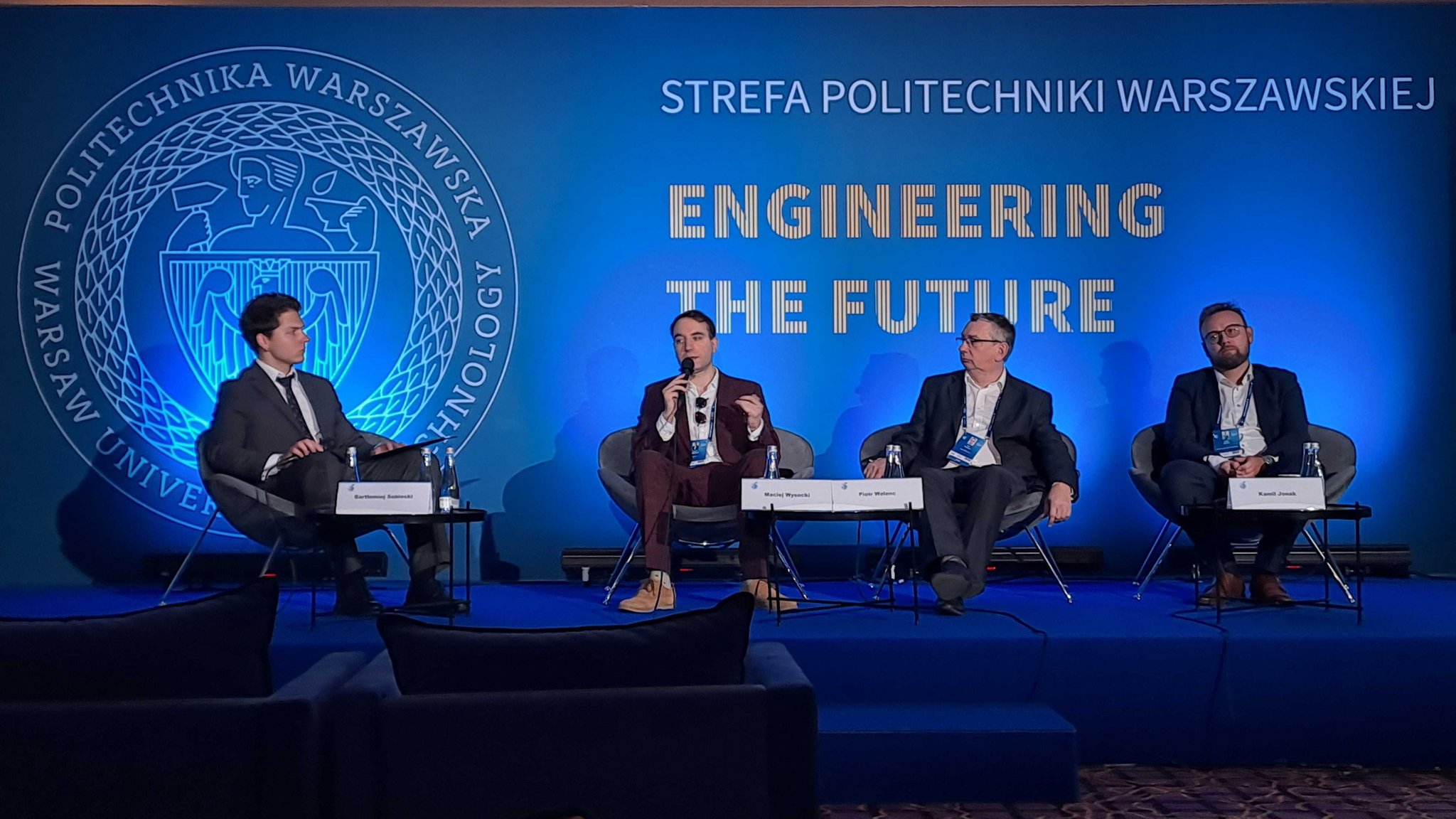
On 9 September, Bartłomiej Sobieski moderated "Po pierwsze nie szkodzić: czy AI jest gotowa na autonomizację procesów biomedycznych? (First, do no harm: is AI ready to run biomedical processes autonomously?)". His guests were Piotr Welenc, director of the Audit and Certification Centre at the Independent Public Clinical Hospital named after Andrzej Mielęcki, Kamil Jonak, dean of the Faculty of Mathematics and Information Technology at Lublin University of Technology and Director of the Regional Centre for Digital Medicine, and Maciej Wysocki, CEO of BioCam.ai. The conversation asked which biomedical processes can already be handed over to AI without a human in the loop, who is accountable when a model is wrong, and how much verification a system needs before a clinician, a patient and a regulator can trust its output.
AI in Finance
The same afternoon, Kamil Książek moderated "Zarząd vs algorytm: kto zapłaci za halucynacje i błędy AI wdrażanej w sektorze finansowym? (Management board vs. algorithm: Who will pay for AI's hallucinations and mistakes in finance?)". The panel brought together Tadeusz Białek, president of the Polish Bank Association, Tomasz Mironczuk, Vice President of Bank Ochrony Środowiska and CEO at the Institute of the Financial Market, Aleksandra Tomaszewska, director of the Research and Innovation Department at the Ministry of Digital Affairs, Anna Gomola of the Krakow University of Economics and Associate Director of UBS, and tax advisory expert Zbigniew Makowski. The experts agreed that, at this stage, none of them would hand the management of their own finances over to an autonomous AI model.
AI in Defence and Cybersecurity
On 10 September, Kacper Gradoń, Associate Professor in Cybersecurity at the Warsaw University of Technology and honorary Associate Professor at UCL's Department of Security and Crime Science, moderated "Sztuczna Inteligencja, a Cyberbezpieczeństwo i Obronność: czy jesteśmy w stanie zapanować nad technologiami dual user? Edukacja, regulacja, technologia. (Artificial Intelligence, Cybersecurity and Defence: can we keep dual-use technologies under control? Education, regulation, technology)." His guests were Wojciech Nowakowski, director of the cybersecurity office at Orlen, Anna Felkner, director of cybersecurity research and development at NASK, and Paweł Kuźmiak, managing partner at DSK law firm. Here too, the speakers were strongly cautious about using AI models without restrictions.
More from Karpacz
Members of the Centre were also active beyond our own series. On 10 September, Tomasz Steifer, who leads the BLUE-XAI team at the Centre, joined the panel "System VAT w Polsce. Czy potrzebujemy nowej ustawy o VAT? (The VAT system in Poland: do we need a new VAT Act?)" in the main Forum programme, moderated by Aleksandra Prorok, Communications Coordinator for the New VAT Act at the Institute of Taxes and Public Finance, alongside Agnieszka Durlik of the Polish Chamber of Commerce, Leszek Lewandowicz of the Accountants Association in Poland, Mateusz Lewandowski of the Warsaw University of Technology, Zbigniew Makowski of the Institute of Taxes and Public Finance and Leszek Skiba of the Sobieski Institute. The debate asked whether a VAT Act amended more than 120 times in twenty years can still be repaired or needs to be rewritten, and what role verifiable AI tooling could play in a tax system that is increasingly automated.
On 9 September, Bartosz Naskręcki, a researcher at the Centre and Vice-Dean of Mathematics and Computer Science at Adam Mickiewicz University in Poznań, took part in the "What's Up (with) AI" panel in the University of Warsaw zone, alongside Piotr Sankowski, Director of IDEAS Research Institute and Professor at the University of Warsaw, Andrzej Dragan, Professor of Physics at the University of Warsaw and Visiting Professor at the National University of Singapore and Przemysław "Psyho" Dębiak, former OpenAI engineer and winner of the AtCoder World Tour Finals 2025, where he was the only contestant to beat OpenAI's model, moderated by Tomasz Bojęć, Head of Technology Transfer at IDEAS Research Institute. The conversation turned on the shift from writing programs that perform tasks to writing programs that build other programs, and on what that shift means for research itself.
Thank you to all our guests, and to the Foundation for Polish Science and the Warsaw University of Technology Innovation Centre (CINN PW) for their support.